You can spend a lot of money on a dessert table. Elaborate cakes, plated pastries, a full macaron tower. And guests will admire it all — briefly — before migrating toward the chocolate fountain.
It’s not snobbery in reverse. It’s just that a flowing chocolate fondue fountain is interactive in a way that a cake on a stand isn’t. People can do something with it. They pick a skewer, choose what to dip, and make something small that’s entirely theirs. That participation is what makes it memorable.
This post covers how fountains actually work, what chocolate to use, what to put out for dipping, and the handful of practical things that separate a smooth setup from a sticky, uneven mess halfway through an event.
From Fondue Pot to Flowing Fountain
Chocolate fondue — a communal pot of melted chocolate, shared skewers, everyone crowding around — caught on in the 1960s as part of the wider fondue craze. It was warm, informal, and social. It also had obvious limitations: one small pot, inconsistent heat, and a gathering radius of about four people before it became awkward.
The self-circulating fountain solved those problems. A Canadian company called Design & Realisation developed the cascading mechanism in the 1990s. The U.S. company Sephra commercialized it for the event market, and it became a standard feature at upscale weddings and catered functions within a few years.
Home versions arrived not long after — smaller, less expensive, designed for a kitchen counter rather than a banquet hall. By the early 2000s, a fondue fountain had become a common gift registry item and a fixture at birthday parties and holiday events.
The reason it replaced the fondue pot isn’t aesthetic. It’s mechanical: continuous circulation keeps the chocolate at an even temperature throughout, and the cascading tiers let multiple people dip simultaneously without fighting for position around a single bowl. That’s a practical improvement worth understanding, because it’s also why setup and chocolate preparation matter so much — the machine does real work, and it only does that work properly when the chocolate is the right consistency.
How the Mechanism Actually Works
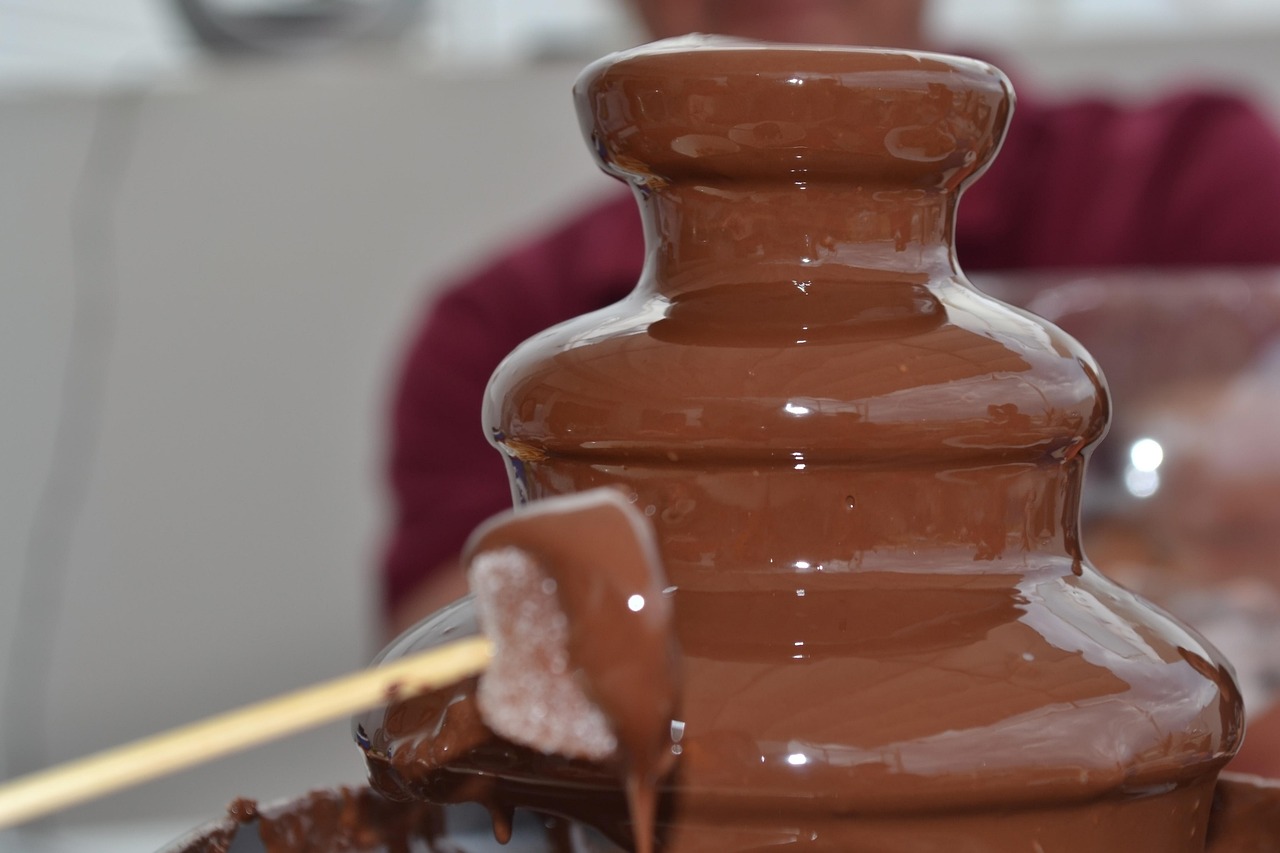
The design is straightforward once you see it. A heated base keeps the chocolate warm and fluid. An internal auger — a corkscrew-shaped mechanism — pulls the chocolate up through the center column to the top tier. From there, gravity takes over: the chocolate flows down over a series of stacked plates and returns to the basin, where the auger picks it up again.
That loop runs continuously as long as the machine is on and the chocolate stays fluid enough to move.
Fluid enough is the phrase that causes most fountain failures. Chocolate straight from a bar or a bag of chips is too thick for most fountain augers to handle efficiently. The pump strains, the flow becomes uneven, and chocolate stops reaching the top tier — which means it stops cascading entirely and just gurgles at the base.
The solution is oil, added before the chocolate goes into the fountain. A roughly 1:6 ratio — one tablespoon of neutral oil per cup of chocolate — thins the consistency enough for smooth circulation without making the chocolate greasy or affecting the flavor noticeably. This step isn’t optional. It’s the difference between a fountain that runs properly for three hours and one that needs constant intervention.
My strong recommendation: do a test run at home before any event. Melt your chocolate, add the oil, run the fountain for ten minutes, and watch the flow. Adjust the oil ratio if needed. Doing this the day before costs 20 minutes. Troubleshooting it at the event costs considerably more.
Picking the Right Chocolate Fountain Chocolate
Couverture is the professional choice. It has a higher cocoa butter content than standard retail chocolate, melts more smoothly, and produces a cleaner coat on whatever you’re dipping. If you can source it through a specialty retailer or wholesale supplier, it’s worth the extra cost for a large event.
For smaller gatherings or tighter budgets, good-quality chocolate chips or broken bar chocolate both work — as long as you add oil and melt everything before it goes into the machine. The type of chocolate changes the flavor profile and behavior:
- Milk chocolate: Sweet, creamy, the crowd default. Works for all ages and most flavor pairings. Tends to thicken faster as it cools than dark chocolate does, so keep your heat setting consistent and don’t let it sit idle.
- Dark chocolate: Richer, more bitter, noticeably better with fruit. Chocolate strawberries dipped in a good dark chocolate fountain are one of the better things you can put on a dessert table — the acidity of the berry and the bitterness of the chocolate balance each other in a way that milk chocolate doesn’t achieve. Dark chocolate also flows more readily at lower temperatures because the higher cocoa butter content keeps it fluid longer.
- White chocolate: Mild and vanilla-forward. Can be tinted with oil-based food dyes for themed events. Needs closer temperature monitoring than other types — it scorches faster and the flavor turns acrid if it overheats.
- Flavored varieties: Mint, caramel, and fruit-infused chocolates work in fountains when the base is cocoa butter-rich. Avoid flavored coatings that list vegetable fat as the primary ingredient — they flow inconsistently and taste noticeably cheap once diluted by the warmth of the fountain.
One thing worth knowing about chocolate fountain chocolate specifically: the brand matters less than the ingredient list. Look for a short list with cocoa butter high up. Long lists with multiple fats and emulsifiers are usually a sign you’re buying a coating product rather than actual chocolate.
The Strawberry Lesson From a Catered Reception
A catering manager set up a chocolate fondue fountain at a 120-person wedding reception. Dark chocolate, well-prepared, running smoothly. The dipping table had marshmallows, pound cake cubes, pretzels, brownie bites, and two large platters of chocolate strawberries pre-dipped as decoration.
The strawberries were gone in under fifteen minutes. Not the pre-dipped ones — guests had eaten those while the caterer was still finishing setup. Fresh strawberries from the dipping tray: gone in fifteen minutes.
The marshmallows and cake cubes sat largely untouched. Guests wanted to dip fruit themselves, specifically strawberries, and they wanted more of them than anyone had planned for.
The caterer sent a runner to buy additional punnets from a nearby shop. They were gone within twenty minutes of arriving.
The practical lesson: when planning your dipping spread, buy at least double the fresh fruit you think you’ll need, and expect strawberries to go three times faster than anything else. People gravitate toward fresh fruit over baked goods when a fountain is involved — the combination of warm chocolate and cold, slightly tart fruit is just more interesting than chocolate on cake.
What to Dip — and What to Keep Away From the Fountain
The best dippables are sturdy enough to hold their shape on a skewer and structured enough not to crumble into the flowing chocolate.
What works well:
- Fresh fruit — strawberries, pineapple chunks, banana slices, grapes, apple wedges, orange segments
- Baked goods — brownie bites, pound cake cubes, biscotti, mini donuts, churro pieces
- Savory-sweet — pretzels, salted crackers, thick-cut potato chips (the salt-chocolate contrast is better than most people expect)
- Confections — marshmallows, rice cereal treats, dried apricots, candied ginger
What to avoid: anything with a crumbly or flaky texture. Shortbread, dry scones, loose cookies, and anything heavily dusted with powdered sugar all disintegrate in warm chocolate and contaminate the fountain within a few dips. The debris sinks to the basin, gets picked up by the auger, and ends up recirculated through the chocolate — which affects both flow and flavor.
When in doubt, test a piece in a small bowl of warm melted chocolate before adding it to the dipping spread. If it falls apart, leave it out.
The Setup Details That Actually Matter
- Melt before you pour: Never add solid chocolate to a running fountain. Melt the chocolate and oil together completely, then pour the warm, fluid mixture in before switching the machine on. Starting with solid chocolate strains the auger and can damage the motor.
- Level it properly: Even a small tilt causes the chocolate to flow heavier on one side and barely reach the other. Use the adjustable feet, check with a spirit level if you have one, and test the flow before guests arrive.
- Keep backup chocolate warm: A popular fountain at a large event can run through chocolate faster than expected. Keep a reserve portion warm in a separate bowl and top up the basin as needed rather than waiting until flow starts dropping off.
- Use proper skewers: Bamboo skewers or fondue forks keep hands away from the flowing chocolate and make dipping cleaner and faster. Toothpicks are too short; fingers are obvious.
- Clean it the same night: Warm chocolate wipes off in a few minutes. Hardened chocolate requires soaking, scraping, and significant patience. Disassemble and wash all components while the chocolate is still warm — ideally within 30 minutes of switching the machine off. This is the step most first-time fountain hosts skip and regret.
The cleanup timeline is the one I’d emphasize most strongly. It sounds like a minor detail. It isn’t. Chocolate that has fully hardened inside an auger mechanism takes hours to clean properly. Warm chocolate takes minutes. Set a phone reminder if you need to.
Is a Chocolate Fountain Worth the Setup?
For the right event, yes — and the answer is less about the fountain itself than about what it does to the room.
A fondue fountain gives guests a reason to stand in one place, interact with each other, and stay engaged with the dessert table for longer than they would with a static spread. That social function is real and it’s the main reason fountains get requested at event after event despite requiring more preparation than simply putting out a cake.
The chocolate fondue fountain format specifically — continuous circulation, self-serving, consistent temperature — is better suited to events with more than 20 or 30 guests than traditional fondue ever was. It scales in a way a pot doesn’t.
Get the chocolate right, level the machine carefully, put out more strawberries than you think you need, and clean it before you go to bed. That covers most of what you need to know.